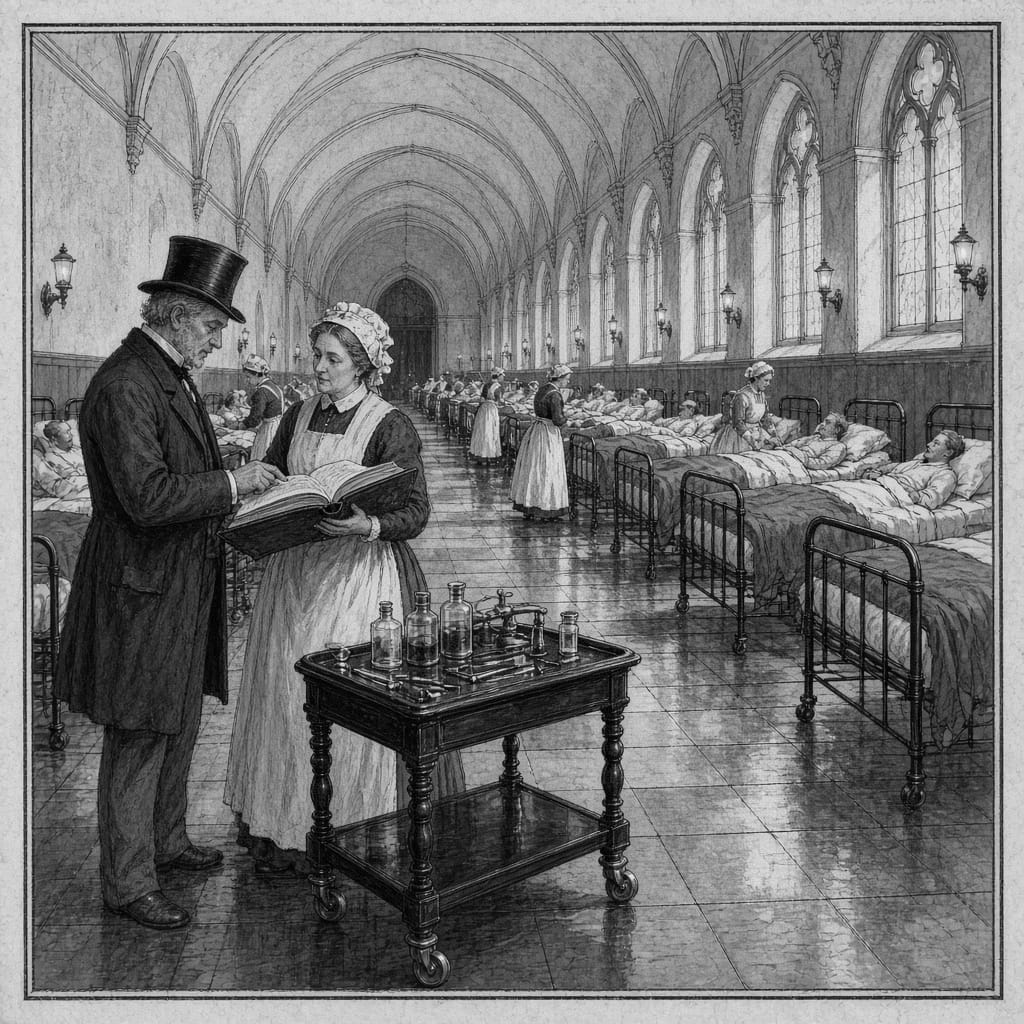
The Filing Cabinet Versus the Shop Floor
I have been watching the search traffic for "hca healthcare layoffs" spike through the roof over the last thirty days. Whenever a massive health system trims its roster, the internet immediately assumes the worst. I have seen this movie, and let me save you an afternoon. The robots are not coming for your stethoscope, and the clinical job market is not collapsing.
HCA Healthcare, a sprawling system operating 190 hospitals, did indeed announce cuts in September 2026. When the news broke, it was easy to see why the search algorithms went wild. The headline looked like the beginning of a broader collapse. They lowered their financial guidance, citing an estimated $1.2 billion hit from changes related to uninsured patients and the Affordable Care Act. When hospital margins get thin, executives stare at a well-kept ledger and look for salaries to trim.
But if you look at who actually packed up their desks, the panic evaporates. The company eliminated a small percentage of roles in their corporate office and support functions. Meanwhile, their own spokespeople confirmed they are still actively hiring for clinical roles across the country to support patient care. They are sweeping out the filing cabinets, not the shop floor.
Why the Robots Cannot Replace the Clinic
This is a durable principle in healthcare hiring. Administrators do not cut the people generating the billable care.
If you read the broader labor tea leaves, you see the exact same pattern playing out across the economy. The outplacement firm Challenger, Gray and Christmas tracks the stated reasons for corporate job cuts. Their summer 2026 reports show that companies are indeed shedding jobs and reallocating those budgets toward new capabilities, often citing artificial intelligence as the reason. The technology sector is taking an absolute beating as organizations squeeze their middle ranks.
But healthcare is a distinctly physical business. While a software firm might feel entirely comfortable replacing a junior copywriter with a statistical language model, a hospital cannot automate a catheter insertion. Patient safety requires human hands, rigorous certification, and legal accountability. That kind of risk management cannot be automated away by the fashion of the moment. The cuts happening in healthcare are about corporate cost containment, not clinical automation.
The Bar Chart That Proves Your Leverage
The government labor data backs this up without a stutter. The Bureau of Labor Statistics, the federal agency that tracks employment and economic trends, just updated its ten-year occupational projections. They estimate that the total workforce will grow by 3.5 percent between 2025 and 2035. That is a slow, steady, unremarkable simmer for the broader economy.
But if you look at the government's bar chart for occupational growth, healthcare support sits at the very top. The chart shows healthcare support occupations jumping by 13.3 percent over that same decade. Just behind it, healthcare practitioners and technical roles are expected to grow by 8.0 percent. The federal government expects those two categories alone to account for nearly a third of all new jobs created in the entire country.
Those percentages represent real hiring budgets. The data proves that while hospital executives are perfectly happy to outsource their payroll departments, they are forced to compete fiercely for anyone who actually touches a patient. The leverage belongs entirely to the clinical staff.
The One Metric That Outlasts the Cycle
In raw numbers, the picture is even brighter. The government estimates that healthcare occupations will generate roughly 1.9 million job openings every year. Those openings come from a mix of new roles being created to handle an aging population, and the natural churn of older workers retiring or leaving the field.
When an experienced nurse or a specialized technician retires, that hospital has an immediate, legally mandated hole to fill. They cannot simply tell an algorithm to cover the night shift. That 1.9 million figure is a baseline of guaranteed demand, built on the unavoidable realities of human biology. If you are standing at the bedside, your bargaining power is practically welded to the floor.
Anchor Yourself to the Revenue Center
This brings us to the lesson. Corporate healthcare systems will always chase efficiency, and their back-office staff will always absorb the blow when the math goes wrong. Middle management, marketing coordinators, and backend administrative staff are usually the first to go because their work, while useful, is disconnected from the physical reality of patient safety and clinical revenue.
You do not need PorkiMail to tell you that the safest place to weather a corporate storm is inside the revenue center. In healthcare, the revenue center is the clinic, the emergency bay, and the operating room. Employers will always look for ways to protect their profit margins. Make sure your daily work is the thing protecting those margins, rather than the overhead they trim to save them.
My advice to you is simple. If you are applying for healthcare roles today, stay as close to the patient as your credentials allow. If your background is in administration or operations, you must aggressively tie your past work directly to patient outcomes or clinical efficiency. Stop talking about how you facilitated abstract synergies, and start proving how your logistics kept the supply room stocked for the surgical teams. Anchor yourself to the work that actually keeps the lights on.