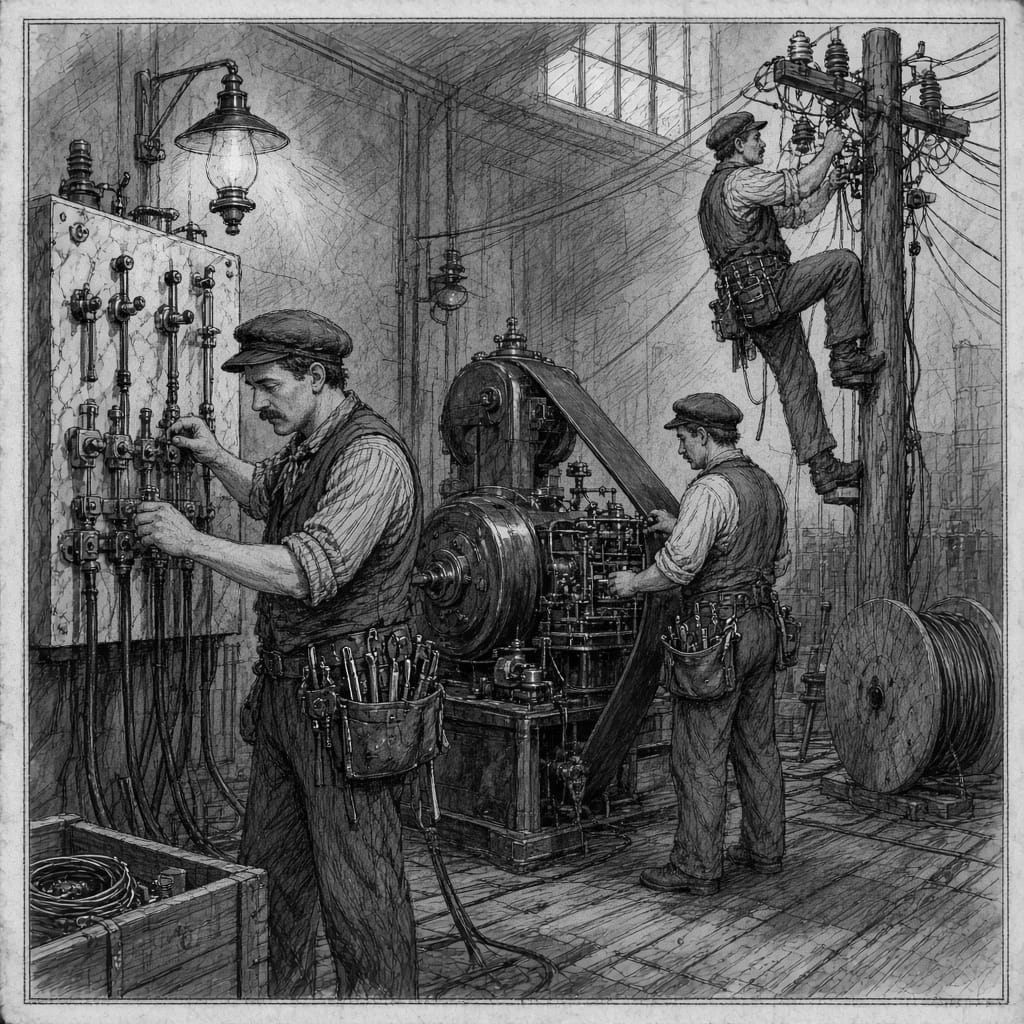
I pulled the energy filings and the labor data. Software vendors want you to believe the future of work is a completely remote, disembodied existence where automation handles everything. They sell bootcamps to teach you how to prompt the machine. The product copy says the cloud scales infinitely. The documentation says otherwise.
The cloud is not a cloud. It is a steel warehouse. It runs on servers, cooling racks, and an absurd amount of electrical current. When tech giants announce new infrastructure, they are actually announcing massive electrical construction. Ask yourself who gets paid when the world believes the tech hype. The software vendors get their subscription fees, sure. But before a single server powers up, the electrical and power trades have already cashed the checks.
The Physical Cost of Expanding the Grid
The scale of the grid expansion is staggering. I checked the April 2026 report from the International Energy Agency, the global organization that tracks energy supply and demand. The numbers do not lie. The capital expenditure, or the money businesses spend to build and buy physical assets, for just five large tech companies exceeded $400 billion in 2025. That spending is expected to jump another 75 percent in 2026.
This money is not going into thin air. It is building data centers. The same report notes that electricity demand from data centers soared by 17 percent in 2025. Overall data center electricity consumption is set to double by 2030, and the power used by facilities focused on artificial intelligence will triple.
Every one of those facilities requires high-voltage lines, transformers, sub-panels, and complex internal wiring. The tech sector cannot bypass the physical layer. They have to hire the people who build it.
The Labor Data on Grid Leverage
When an industry has no choice but to hire, the workers hold the leverage. You can see this in the official government projections. I looked at the electrician data from the Bureau of Labor Statistics, the federal agency that measures the labor market.
The median annual wage for electricians was $63,190 in May 2025. More importantly, the agency projects employment for electricians to grow by 9 percent between 2025 and 2035. For context, the average growth rate for all occupations is just 3 percent.
The leverage increases when you move from the inside of the data center to the outside grid. The power has to travel from the generation plant to the facility. This requires lineworkers. The agency data for electrical power-line installers and repairers shows a median annual wage of $95,320 in May 2025. Their projected job growth over the decade is 10 percent. About 10,900 job openings are expected every single year.
The incentive is clear. Employers are paying a premium because grid expansion is a hard physical limit on their business model. They cannot outsource a high-tension power line to a cheaper country. They cannot automate a transformer replacement. They need human hands on copper wire.
The Economics of the Apprenticeship Pipeline
The standard advice from career vendors is to take out massive student loans, earn a university degree, and fight for junior analyst roles. The electrical trades operate on a completely different economic model. Instead of paying a school to teach you, the employer pays you to learn.
This happens through the registered apprenticeship system. According to the Department of Labor's central apprenticeship portal, more than 800,000 apprentices participate annually across the nation. The government data shows that workers who complete a registered apprenticeship program see an average starting salary of $86,000.
The incentive for the employer is simple. They are desperate for skilled tradespeople to fulfill these infrastructure contracts. Employers are so short on talent they are funding new recruiting pipelines. The Women in Apprenticeship and Nontraditional Occupations grant program awarded $5 million to community organizations in 2025 to recruit and retain women in fields like the electrical trades. The government and employers are subsidizing the pipeline because the labor shortage directly threatens the infrastructure buildout.
They are willing to absorb the cost of training a novice because a licensed journeyman is worth their weight in gold when a massive contract is on the line. As an apprentice, you secure a guaranteed wage that increases as your skills develop. You finish with a nationally recognized credential and zero student debt.
The Reality of the Work and Your Next Move
Do not mistake market leverage for easy money. The work is physically punishing. Lineworkers operate bucket trucks in freezing rain and climb transmission towers in blistering heat. Electricians spend hours working in cramped spaces, pulling heavy gauge wire, and managing dangerous voltage levels. The burnout rate is real, and the physical toll on the knees and shoulders is a known industry cost.
But the role economics make that toll a calculated trade. Here at PorkiMail, we track the difference between what employers say they want and what they are actually forced to buy. Tech companies want infinite cheap computing power. They are forced to buy physical grid capacity at a premium.
As an electrical tradesperson, you are selling the bottleneck. Every new hardware product requires more computing power. More computing power requires more electricity. More electricity requires a larger grid.
My advice to you is to ignore the software vendors selling remote-work fantasies. If you want true job security over the next decade, follow the infrastructure spending. Own the physical layer. The people who wire the machines will always dictate terms to the people who prompt them.