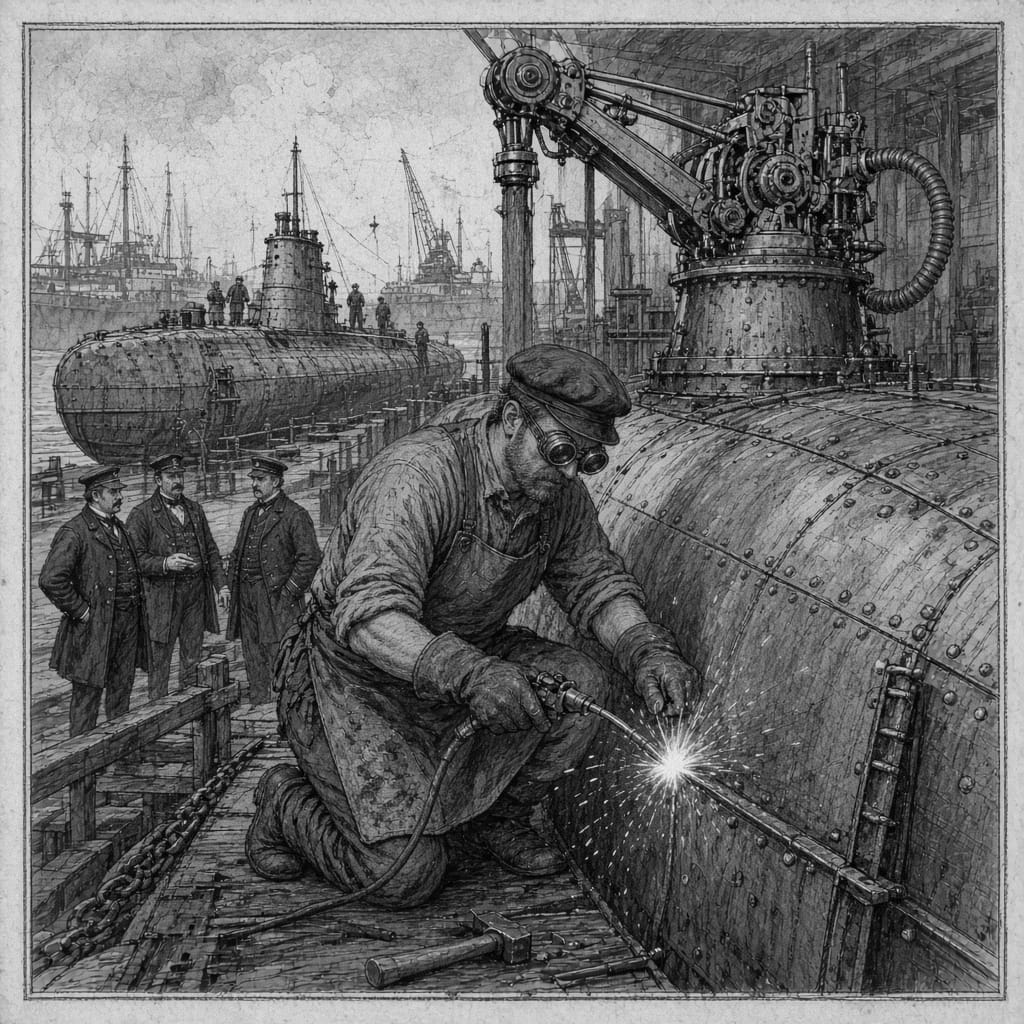
The vendor brochure for the latest collaborative welding robot sits on my desk. The glossy copy promises to solve the manufacturing labor crisis by replacing skilled human operators with a mechanical arm. I read the product claims. Then I pulled the federal shipbuilding requirements.
The U.S. Navy disagrees.
Robots can lay beautiful beads in controlled environments. But a robotic arm cannot assume legal liability for the structural integrity of a nuclear submarine. If a weld fails at test depth, the Department of Defense does not sue the machine. They audit the paper trail.
Hiring managers in defense and heavy industry are not just filtering for someone who can fuse metal. They are filtering for the legal transfer of risk. That distinction is tearing the industrial fabrication labor market in two, separating the workers competing against automation from the workers leveraging it.
The Numbers Behind the Shortage
Who benefits when workers believe automation will take their jobs? Employers who want to suppress wages benefit. But the labor data shows the leverage is entirely on the side of the certified human welder.
The Bureau of Labor Statistics projects that employment for welders, cutters, solderers, and brazers will grow just 2 percent from 2025 to 2035. That sounds like a stagnant market until you look at the replacement rate. The government expects 40,300 job openings for welders every year. Those openings are driven entirely by churn, meaning workers transferring to other occupations or retiring, rather than the total number of jobs expanding.
Industry watchdogs track the pipeline even more closely. The American Welding Society projects that 320,500 new welding professionals will be needed by 2029 to replace an aging workforce.
The gap is most severe in defense contracting. The Technical Education Post reports that the Navy estimates it will need 140,000 skilled workers just to meet submarine construction and maintenance requirements. About 100,000 of those workers are needed for new construction alone. You cannot bridge a gap that wide with robotic arms.
The Liability Filter
The gatekeepers at defense contractors do not care about a candidate's speed on a commercial bench. They care about compliance. The federal manual that dictates how welding is performed on Navy vessels is called NAVSEA Technical Publication S9074-AQ-GIB-010/248.
According to industry guides like the one from Lynn Welding, this NAVSEA standard requires employers to maintain a rigorous quality assurance system. Individual welders must qualify under their employer's specific program. You cannot just buy a defense certification on your own as an independent contractor without a compliant quality system. The employer pays a premium for the worker's ability to execute a written procedure exactly as mandated, and to document every step.
This creates a hard ceiling for uncertified shop workers and a massive premium for those who clear the federal gates. Employers pay heavily for workers who can pass non-destructive testing (NDT). NDT is a method of inspecting the inside of a weld without breaking it open, usually using x-rays or ultrasonic waves. A failure on an NDT inspection costs the employer time, materials, and reputation.
The Physical Toll and Your Next Move
A robot can weld a straight seam on a flat table all day. A human welder who can crawl into a confined space, heat a joint, and pass an ultrasonic test holds all the cards. As Business Insider reported this year, the grueling physical demands of shipbuilding mean younger workers are leaving for less physically demanding jobs in data centers and light manufacturing. That physical attrition only increases the leverage for the welders who stay and certify.
If you are entering the welding trade or looking to move up, stop competing on raw output. The machine will eventually beat you on volume. Uncertified commercial shops will always try to pay you less by pointing to the robots.
Build your career around liability, complexity, and compliance. My advice to you is to get into a shop that pays for your defense, aerospace, or structural certifications. We follow these shifting incentives closely at PorkiMail, because understanding where the capital flows is the only way to protect your paycheck. The gatekeepers at defense companies are not screening for how fast you work. They are screening for your signature on the inspection report.